Skip to content

Myopia Management in Cypress

Myopia management is designed to slow the progression of nearsightedness in children. At Strong Vision, we create individualized plans based on each child’s prescription, eye growth, age, lifestyle, family history, and ability to use a treatment consistently.

Managing myopia cannot reverse nearsightedness that has already developed. However, slowing its progression may help reduce the likelihood of a child developing high myopia and the associated risk of retinal detachment, glaucoma, cataracts, and myopic macular degeneration later in life.
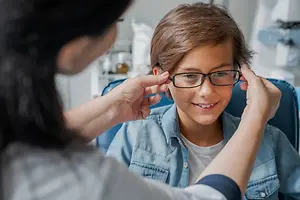

A young boy with glasses is having his ears checked by an adult woman, possibly in an optometrist's office.

What Is Myopia?

Myopia, commonly called nearsightedness, causes distant objects to appear blurry while nearby objects may remain easier to see. It often develops when the eye grows too long from front to back, causing incoming light to focus in front of the retina instead of directly on it.

Myopia commonly begins during childhood and may progress as the eyes grow. Standard eyeglasses and contact lenses correct blurry vision, while myopia management treatments are selected specifically to help slow further progression.

little girl in a blue sweater covering her eyes with her hands at the optometrist's office

Strong Vision Starts With Strong Vision Center

How Do I Know If My Child May Be Nearsighted?

Children do not always recognize or report changes in their vision. Consider scheduling a pediatric eye exam if your child:

  • Squints when viewing distant objects 
  • Sits close to the television or classroom board
  • Holds books or devices very close
  • Complains of headaches or eye strain
  • Has difficulty seeing at school or during sports
  • Has a prescription that changes frequently
  • Has one or two parents who are nearsighted

A comprehensive eye exam can determine whether your child has myopia and assess factors that may increase the likelihood of progression.

A boy wearing glasses is reading a book on his bed.
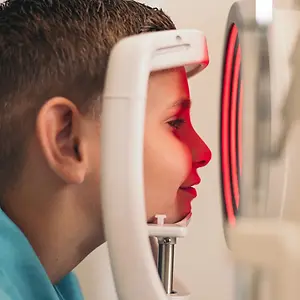
A young boy having his eyes examined by an eye doctor using an optical instrument.

Our Myopia Management Options

No single treatment is right for every child. Our optometrists will explain the benefits, limitations, care requirements, and potential risks of the appropriate options before recommending a personalized plan.

What Is the Connection Between Near Work and Myopia?

Near work includes activities performed within arm’s reach, such as reading, writing, drawing, completing homework, using a smartphone or tablet, and working at a computer. Research has found associations between myopia and certain patterns of prolonged or very close near work, although genetics, outdoor exposure, education, and other factors also play a role.

Digital devices have not been proven to be the sole cause of myopia, and reducing screen time alone may not prevent it. A balanced routine that includes outdoor activity, comfortable working distances, and regular visual breaks can support healthy visual habits.

A girl is smiling while looking at her tablet in a classroom
Two children playing in a grassy field with a colorful pinwheel

Why Is Outdoor Time Important?

Spending time outdoors is one of the most consistently supported lifestyle factors associated with a lower likelihood of developing myopia. Outdoor activity cannot guarantee that a child will avoid nearsightedness, particularly when genetic risk is present, but it can be an important part of a healthy routine.

Parents can encourage regular outdoor play while following appropriate sun-safety measures. Once myopia has developed, outdoor time should complement professional monitoring and treatment rather than replace them.

How Can Ortho-K Help Young Athletes?

Glasses can fog, shift, or become damaged during sports, while daytime contact lenses may become uncomfortable in dry, dusty, or windy environments. Ortho-k allows eligible athletes to participate during the day without wearing glasses or contact lenses.

This can be especially useful for sports involving helmets, goggles, physical contact, water, or frequent changes in direction. Ortho-k does not guarantee perfect vision or athletic performance, and some patients may notice that the effect decreases later in the day. A detailed fitting and consistent overnight wear help us determine whether it is a practical option.

Before fitting ortho-k lenses, we examine the eyes and use corneal topography to create a detailed map of the corneal surface. The lenses are then custom designed, and follow-up visits allow us to assess vision, lens fit, corneal health, and myopia progression.

Four girls playing field hockey on a grassy field with trees in the background
A woman and a girl are sitting in front of a desk, possibly in a kitchen, and they seem to be working on a project. The woman is smiling while looking at the girl, who is holding a pencil and a pen. The desk has a laptop, notebooks, and other items. Behind them is a countertop with a sink, a coffee cup, and a knife holder.

Is My Child a Candidate for Myopia Management?

Myopia management may be considered for children who already have myopia or who show signs that their prescription is likely to progress. Relevant factors include:

  • Age when myopia first developed
  • Current prescription and rate of change
  • Eye length, when measurements are available
  • Family history of myopia
  • Amount of outdoor and near-work activity 
  • Eye health and corneal shape
  • Interest in glasses, daytime contacts, or overnight lenses 
  • Ability to follow treatment and hygiene instructions

There is no single minimum prescription or narrow age range that applies to every child. An individualized evaluation is the best way to determine when treatment should begin and which option is most appropriate.

Myopia Management FAQs

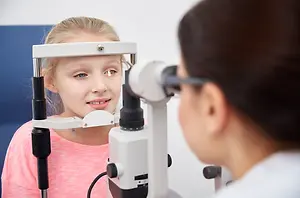
A young girl with blonde hair is having her eyes examined by a doctor in an eye clinic.

Schedule a Myopia Management Consultation

If your child is becoming more nearsighted or has risk factors for myopia, Strong Vision can help you understand the available options. Schedule a myopia management consultation in Cypress for an individualized evaluation and treatment recommendation.